Choosing the 2026 Best Marine Inverter for Boats Worldwide requires more than comparing wattage and price. A reliable Marine Inverter must match the boat’s battery bank, onboard appliances, charging system, and cruising environment. Salt spray, engine vibration, limited ventilation, and sudden electrical loads can expose weak designs quickly.
Nigel Calder, a respected marine electrical author, offers practical guidance: “Keep the connections clean, tight, and dry.” This simple warning remains relevant. A high-quality inverter can still fail because of loose terminals, undersized cables, or poor airflow. Real-world reliability begins with installation.
This guide examines pure sine wave output, continuous and peak power, standby consumption, cooling systems, protection features, and certification evidence. It also considers 12-volt, 24-volt, and 48-volt systems used on modern boats. Some models appear impressive on paper. They may disappoint at anchor.
Our evaluation focuses on measurable performance and practical ownership experience. We consider how an inverter behaves when running refrigeration, navigation equipment, pumps, induction cookers, and sensitive electronics together. We also question common assumptions. Bigger is not always better. The most expensive unit may not suit every vessel.
Readers should verify regional electrical requirements and consult qualified marine technicians before installation. Specifications can change between markets. Even careful comparisons have limits. Battery condition, cable length, and installation quality can alter results. The best Marine Inverter is therefore not universal. It is the model that delivers stable power, safe operation, and dependable service on your specific boat.
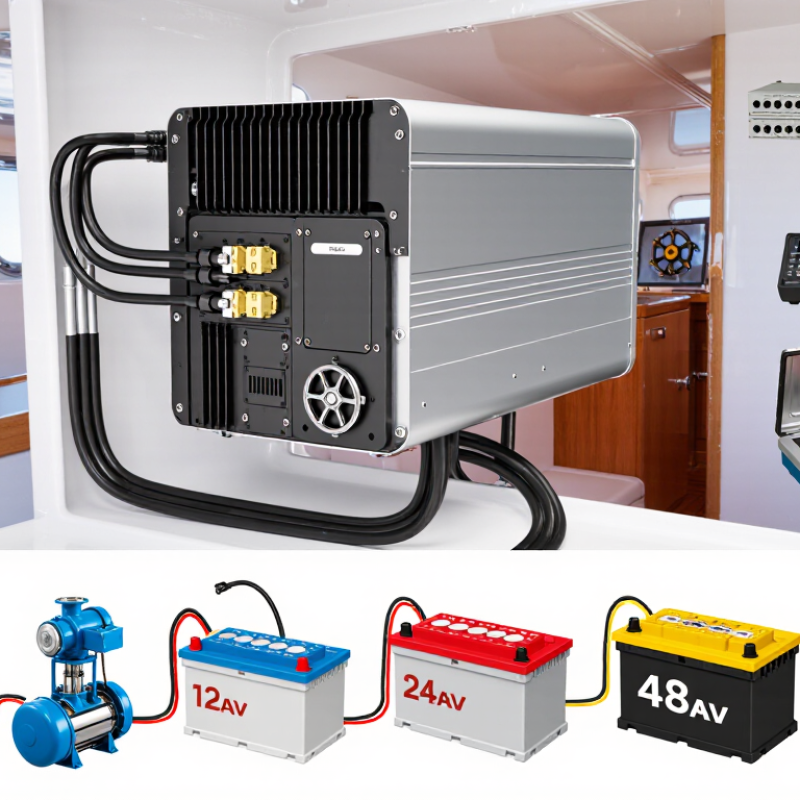
Marine Inverter Basics for Modern Boats
A marine inverter changes battery power into household-style AC power for equipment aboard a boat. It can run chargers, navigation displays, small galley appliances, or a laptop while shore power is unavailable. The inverter does not create energy. Every watt comes from the battery bank, and losses occur during conversion.
Choose the unit by continuous output, surge capacity, waveform, and electrical environment. A pure sine wave model usually suits sensitive electronics and induction motors better. Check the startup demand of refrigerators, pumps, and coffee machines. A device rated for 1,000 watts may struggle with a motor requiring twice that amount briefly. Read the manual carefully. Ratings can be misunderstood.
Installation quality matters as much as inverter size. Use short, correctly sized cables with secure terminals and suitable overcurrent protection. Keep the unit dry, ventilated, and away from fuel vapors or engine heat. Battery voltage should be monitored under load, not only at rest. A low reading may reveal aging batteries, loose connections, or excessive cable length. It is easy to blame the inverter too quickly.
Use a properly designed transfer arrangement when combining shore power and onboard AC circuits. Improvised wiring creates serious shock and fire risks. A qualified marine electrician should verify grounding, bonding, protection devices, and local requirements. I would not treat a household inverter as marine equipment simply because it fits the locker. That shortcut saves space, not risk.
| Selection Dimension | Typical Marine Specification or Range | What It Means on a Boat | Recommended Selection Guidance | Important Practical Check |
|---|---|---|---|---|
| Inverter Function | Converts battery direct current into household alternating current, commonly 120 V or 230 V AC. | Allows selected onboard equipment to operate when shore power or a generator is unavailable. | Choose an inverter, charger-inverter, or inverter/charger according to whether battery charging is also required. | Confirm the AC voltage and frequency match the boat's electrical system and installed appliances. |
| Battery-System Voltage | 12 V, 24 V, and 48 V DC are common marine system voltages. | Higher DC voltage reduces current for the same power, which can reduce cable size and voltage drop. | Use the same nominal voltage as the existing battery bank unless the entire DC system is redesigned. | Never connect an inverter designed for one voltage to a battery bank with a different nominal voltage. |
| Continuous Output Power | Approximately 600 W to 5,000 W for many recreational and cruising applications; larger systems are available. | Defines the total power the inverter can supply continuously under its stated operating conditions. | Estimate the simultaneous running load, then allow a practical reserve of about 20% to 30%. | Check the continuous rating at the expected ambient temperature, not only the headline rating. |
| Surge Output | Often about 1.5 to 3 times the continuous rating for a short period, depending on design. | Supports motor-starting loads such as refrigeration compressors, pumps, and some tools. | Select a unit whose surge rating and duration exceed the starting requirement of the largest motor load. | Starting current can vary significantly with temperature, motor condition, and supply voltage. |
| Output Waveform | Pure sine wave is the preferred option for modern marine electronics and sensitive appliances. | Produces AC power closer to utility power and generally reduces compatibility, noise, and heating concerns. | Use pure sine wave for navigation electronics, audio equipment, medical devices, variable-speed motors, and modern chargers. | Modified-sine output may be unsuitable for some motors, clocks, chargers, and electronic controls. |
| Typical Efficiency | Approximately 85% to 95% near moderate-to-high loads; efficiency is usually lower at very light loads. | Some battery energy is lost as heat during DC-to-AC conversion. | Compare measured efficiency at the loads you actually expect to use, not only the maximum rating. | Idle consumption matters when the boat is unattended or loads remain connected overnight. |
| Idle Consumption | Commonly several watts to several tens of watts, depending on capacity and operating mode. | The inverter can drain the battery even when no AC appliance is running. | Use an energy-saving or standby mode when appropriate, provided essential equipment remains powered. | Measure standby draw at the battery if long-term energy autonomy is important. |
| Battery Current Example | At 12 V, a 1,000 W load can require about 93 A after allowing for 90% conversion efficiency. | High-power AC loads create substantial DC current and can cause voltage drop. | Use adequately sized cables, overcurrent protection, and secure battery connections. | Actual current changes with battery voltage, inverter efficiency, temperature, and load power factor. |
| Battery Capacity Example | A 12 V, 200 Ah battery bank stores about 2.4 kWh of nominal energy. | At 80% usable capacity and 90% inverter efficiency, approximately 1.73 kWh may reach AC loads. | A continuous 1,000 W load could operate for roughly 1.7 hours under these assumptions. | Real runtime is affected by battery chemistry, discharge rate, age, temperature, and cable losses. |
| Transfer-Switch Function | Automatic transfer times commonly range from a few milliseconds to several tens of milliseconds, depending on the design. | Moves selected AC circuits between shore power, generator power, and inverter power. | Choose a transfer arrangement compatible with the boat's shore-power and generator system. | Neutral, grounding, and switching arrangements must follow applicable marine electrical requirements. |
| Built-In Battery Charger | Available in combined inverter/charger units with staged charging profiles. | Uses shore power or generator power to recharge the battery bank while supplying AC loads. | Match the charging profile to the battery chemistry and the battery manufacturer's limits. | Verify charger output, temperature compensation, and compatibility with lithium battery management systems. |
| Battery Chemistry Compatibility | Lead-acid, AGM, gel, and lithium iron phosphate batteries require different charging settings. | Incorrect charging voltage or absorption behavior can reduce battery life or create safety risks. | Use configurable charge parameters and appropriate low-voltage disconnect settings. | For lithium systems, confirm communication, charge control, and disconnect coordination with the BMS. |
| Marine Environmental Protection | Look for documented resistance to vibration, humidity, salt atmosphere, and temperature variation. | Boat interiors can experience condensation, corrosion, engine vibration, and limited airflow. | Install the inverter in a dry, ventilated location away from bilge water and direct engine heat. | Water-resistance claims must be checked against the actual installation location and enclosure rating. |
| Cooling and Ventilation | Many medium- and high-power inverters use temperature-controlled fans or dedicated airflow paths. | Heat reduces efficiency and may trigger thermal protection or power derating. | Maintain the manufacturer's clearance requirements and keep ventilation openings unobstructed. | Do not install inside a sealed battery compartment unless the equipment is specifically approved for that environment. |
| Protection Features | Common protections include over-temperature, overload, short circuit, low battery voltage, and high battery voltage. | Protects the inverter, battery bank, wiring, and connected equipment from abnormal conditions. | Prioritize clearly documented protection thresholds and fault indications. | Electronic protection does not replace correctly rated fuses, breakers, disconnects, and cable insulation. |
| DC Overcurrent Protection | Required close to the battery positive connection and sized for the inverter and cable system. | Limits fire risk if a short circuit occurs in the high-current DC wiring. | Use a marine-rated fuse or circuit breaker with an interrupt rating suitable for the battery bank. | Follow the applicable marine installation standard and the inverter installation instructions. |
| Remote Monitoring | Options may include a wired remote panel, display, Bluetooth, or network communication. | Allows users to view power flow, battery voltage, faults, and operating mode from a convenient location. | Choose monitoring that remains usable at the helm or electrical panel without opening the equipment compartment. | Wireless monitoring should supplement, not replace, accessible local shutdown controls. |
| Installation Location | Dry, clean, mechanically secure, ventilated, and close enough to the battery to limit DC cable length. | Reduces heat buildup, voltage drop, corrosion, and vibration-related failures. | Keep high-current DC cables short while maintaining safe separation from fuel systems and heat sources. | Install according to the vessel's wiring layout, service access requirements, and fire-safety provisions. |
| Load Management | Typical high-demand loads include kettles, water heaters, induction cookers, air conditioners, and power tools. | These loads can quickly exceed inverter capacity and discharge batteries rapidly. | Separate essential loads from nonessential loads and avoid running multiple high-power appliances together. | Use energy monitoring to identify peak demand and improve battery planning. |
| Worldwide Electrical Compatibility | Common systems include 120 V/60 Hz and 230 V/50 Hz, with regional variations. | Voltage and frequency affect appliance safety and whether equipment will operate correctly. | Select output settings that match the vessel's wiring, shore-power system, and onboard appliances. | Do not assume a plug adapter converts voltage or frequency; it normally changes only the physical connection. |
| Best-Fit Application | Small inverter: communications and light electronics; medium inverter: galley and entertainment; high-capacity system: multiple appliances and larger domestic loads. | The right size depends on actual simultaneous demand, battery capacity, and available charging sources. | Choose the smallest inverter that comfortably supports required loads with reserve capacity. | An oversized inverter may increase idle consumption, installation cost, cable size, and battery demand. |
| Planning note: The most suitable marine inverter is determined by the boat's AC voltage and frequency, simultaneous load, motor-starting demand, battery voltage, battery chemistry, charging sources, installation environment, and required safety protections. Ratings and installation practices should always be verified against the equipment manual and applicable marine electrical requirements. | ||||
List each appliance, running watts, and starting surge. Add realistic simultaneous loads. Leave extra capacity for brief peaks.
A refrigerator may use 100 watts while running. Its compressor can briefly demand 600 watts. That short spike matters.
A refrigerator, electronics, and microwave may total 1,080 running watts. A 2,000-watt continuous inverter with 4,000-watt surge capacity offers useful headroom.
Not always. Oversizing can increase idle battery losses. My calculation may still be wrong if actual usage changes at anchor.
A pure sine wave inverter usually provides cleaner power. It can reduce buzzing and protect sensitive equipment. Keep it dry.
On a 12-volt system, 1,000 watts may draw roughly 93 amps after losses. That demands short cables, correct fuses, and a capable battery bank.
Use overcurrent protection near the battery, marine-grade cables, ventilation, and low-voltage shutdown. Separate AC and DC wiring. Label every circuit.
Test charging, alarms, shutdowns, and power transfer. Inspect terminals, cooling paths, and cable insulation regularly. Small details matter.
Choosing the best Marine Inverter for a boat in 2026 requires more than comparing output wattage. This article explains the basics of converting battery power into reliable AC electricity for onboard appliances, electronics, and essential systems. It highlights key features to evaluate, including continuous and peak power, energy efficiency, waveform quality, battery compatibility, remote monitoring, cooling, noise control, and resistance to moisture and vibration. Understanding these factors helps boat owners select equipment that performs consistently in demanding marine environments.
The guide also explains how to match inverter capacity with actual boat power needs by calculating appliance loads, startup surges, usage duration, and available battery capacity. Safety and installation are equally important, with attention to ventilation, proper cabling, grounding, circuit protection, maintenance access, and widely recognized marine electrical standards. Finally, it compares suitable inverter types for cruising, fishing, sailing, emergency backup, and larger onboard power systems, helping users make a practical, safe, and future-ready choice.

 PASS POWER