China Top Car Power Inverter Manufacturers for Global Buyers

Time:2026-09-18 Author:Liam
0%

Choosing a reliable Car Power Inverter manufacturer in China requires more than comparing prices. Global buyers must examine engineering capability, production consistency, certifications, and after-sales support. A low quotation may look attractive, yet hidden costs can appear through unstable output, weak cooling systems, or delayed replacement parts.

This guide explores leading Chinese manufacturers serving international automotive markets. It focuses on practical factors that purchasing teams can verify. These include continuous power ratings, peak capacity, waveform quality, thermal protection, housing materials, and socket design. Factory audits, sample testing, and clear technical documentation also deserve close attention. Small details matter. A loose connector can affect customer confidence.

Experienced manufacturers usually provide structured quality control from component sourcing to final inspection. They may use temperature testing, load testing, aging tests, and electrical safety checks. However, product claims should not be accepted without evidence. Certifications must match the destination market and the specific model, not merely the company brochure.

Buyer requirements differ widely. A logistics fleet may need rugged 24V equipment, while family vehicles often require compact 12V units. Some projects prioritize USB-C charging, quiet fans, or remote monitoring. Others need customized labels and packaging. No supplier is perfect. Even a respected factory can experience communication gaps, production delays, or specification changes. Careful buyers keep written records and approve pre-production samples.

The manufacturers discussed here are assessed through a practical, evidence-based lens. Their strengths, limitations, product ranges, and export experience will help readers create a more dependable shortlist. Good decisions take time. That effort can prevent expensive returns and protect long-term market reputation.
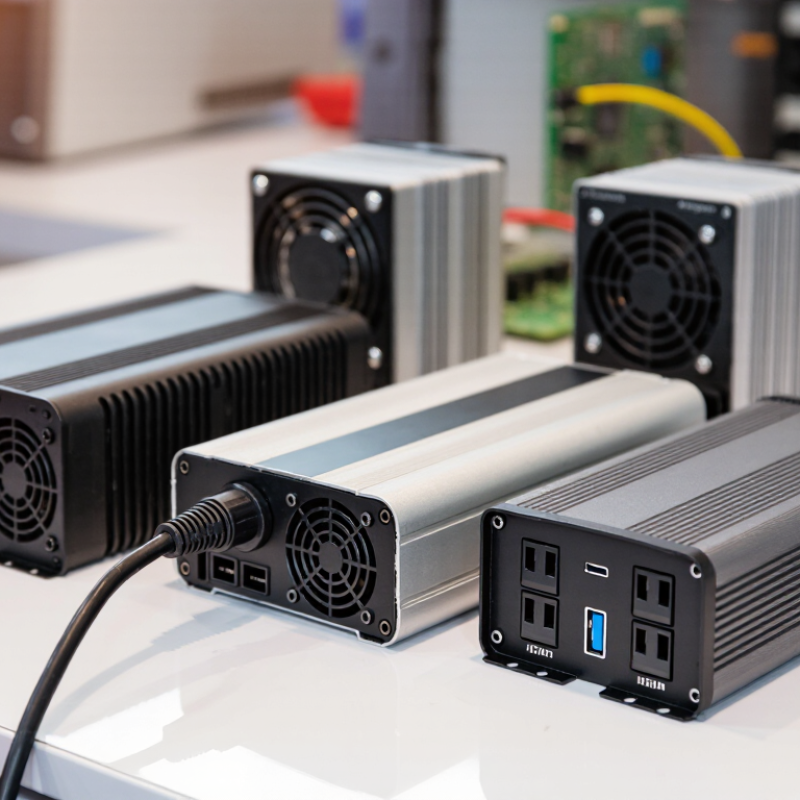
China Top Car Power Inverter Manufacturers for Global Buyers

What Is a Car Power Inverter and How Does It Work?

A car power inverter converts 12-volt or 24-volt direct current into household-style alternating current. It uses electronic switching, filtering, and voltage control. The output may support laptops, camera chargers, medical equipment, or small tools. Not large heaters.

The process begins at the vehicle battery. A control circuit rapidly switches the DC supply, creating a high-frequency waveform. Transformers then adjust the voltage, while filters smooth the output.

Pure sine-wave models produce cleaner electricity. Modified sine-wave models usually cost less, but sensitive devices may run noisily or inefficiently.

The U.S. Department of Energy describes inverters as essential devices for converting battery electricity into usable AC power. That principle also supports modern electric-vehicle systems.

Demand for automotive power electronics is expanding. The International Energy Agency reported over 17 million electric cars were sold worldwide in 2024.

A 2024 MarketsandMarkets study also projects strong growth in the automotive inverter sector through 2030. These figures concern broader vehicle inverters, not only portable cabin units.

That distinction matters. I have seen buyers compare wattage alone, then overlook cable length, fuse ratings, ventilation, and battery condition. A 1,000-watt label does not guarantee continuous 1,000-watt output.

Heat changes performance. So does a weak battery.

Reliable selection requires checking continuous power, peak power, waveform quality, protection functions, and applicable electrical standards. Even careful specifications can disappoint when real vehicle conditions differ.

Key Types and Specifications of Automotive Power Inverters

Automotive power inverters convert a vehicle’s 12V or 24V DC supply into household-style AC power. Some heavy vehicles use 48V systems. The correct input voltage matters; a mismatch can damage equipment or create unsafe heat. Buyers should compare continuous output with peak output, not rely on the larger peak figure. A 300W inverter may handle a laptop, while a 2,000W model suits tools or small appliances.

Modified-sine models usually cost less and support basic chargers, lights, and simple electronics. Pure-sine models provide cleaner power for medical equipment, audio systems, refrigerators, and sensitive motors. Common specifications include 50Hz or 60Hz output, 85–95% efficiency, USB-A or USB-C charging, AC sockets, and cooling fans. Short circuit, overload, low-voltage, over-temperature, and reverse-polarity protection should be clearly listed. Fan noise also deserves attention.

In China’s manufacturing market, experienced suppliers can offer customized housings, cable lengths, display panels, and regional plug standards. Request a complete datasheet, internal protection details, and production quality records. Ask for continuous-load testing under realistic vehicle conditions. A laboratory rating may not reflect hot cabins, weak batteries, or long cables. That part is often underestimated. I would also check standby consumption, because an idle inverter can slowly drain a parked vehicle. Certification documents should match the destination market and the exact model, not a similar product. Suppliers sometimes describe efficiency generously, so independent verification remains worthwhile.

Automotive Power Inverter Types and Typical Specifications

Representative continuous-output ratings commonly used by global automotive buyers

Compact passenger-car inverters typically support low-power electronics, while high-power 12 V, commercial-vehicle 24 V, and 48 V auxiliary inverters are designed for larger equipment. Actual specifications vary by input-voltage tolerance, cooling design, waveform quality, protection functions, and operating conditions.

China’s Leading Car Power Inverter Manufacturing Regions

China’s car power inverter supply chain is concentrated in several strong manufacturing regions. The Pearl River Delta, especially Guangdong, offers dense electronics production. PCB assembly, power semiconductors, connectors, and aluminum enclosures are often nearby. This shortens development and replenishment cycles. The Yangtze River Delta, covering Jiangsu, Zhejiang, and Shanghai, adds precision machining, automotive testing, and export logistics. Its ports support steady global shipments.

The IEA’s Global EV Outlook 2024 reported that China represented about 60% of global electric car sales in 2023. CAAM reported 31.28 million vehicles produced in China during 2024. These figures strengthen demand for vehicle-grade DC-AC converters and accessory inverters. Central regions, including Anhui and Hubei, also deserve attention. They offer growing automotive capacity and competitive labor costs. However, the regional map is not perfectly clean. A factory may assemble locally while sourcing critical components elsewhere. That weakness deserves careful review.

Tips: Ask suppliers for factory addresses, process-flow records, and recent load-test data. Check thermal cycling, electromagnetic compatibility, efficiency, and continuous-output performance. A lower quotation may hide weaker components or limited validation. Verify the production line, not only the sample.

China Top Car Power Inverter Manufacturers for Global Buyers - China’s Leading Car Power Inverter Manufacturing Regions

Manufacturing Region Key Industrial Cities Regional Manufacturing Strength Typical Car Power Inverter Capabilities Component and Supply-Chain Advantages Export and Logistics Profile Best Fit for Global Buyers Regional Suitability
Guangdong Shenzhen, Dongguan, Foshan, Huizhou A major electronics and electrical-equipment manufacturing cluster with strong capabilities in product development, contract manufacturing, tooling, and assembly.
  • Compact 12 V DC to AC inverters
  • Modified-sine-wave and pure-sine-wave models
  • USB, USB-C, cooling-fan, display, and protection-function integration
Dense access to PCB assembly, semiconductor components, connectors, displays, molded housings, cooling systems, and battery-related electronics. Strong international freight connectivity through Shenzhen and nearby Pearl River Delta ports, airports, and cross-border logistics networks. Buyers requiring rapid prototyping, frequent product customization, private-label development, and broad electronic-component sourcing. Very High
Zhejiang Ningbo, Wenzhou, Taizhou, Hangzhou Established private-manufacturing base for electrical appliances, low-voltage equipment, automotive accessories, plastics, metal parts, and consumer hardware.
  • Vehicle accessory inverters for passenger cars and commercial vehicles
  • 12 V and selected 24 V applications
  • Rugged enclosures, cable assemblies, and practical retail-ready designs
Strong local supply of switches, relays, wiring products, injection-molded parts, stamped metal components, fans, and electrical protection devices. Ningbo-Zhoushan is one of the world’s major port complexes, supporting container exports and access to international shipping routes. Importers seeking cost-effective automotive accessories, stable production volumes, and consolidated sourcing of electrical and mechanical parts. High
Jiangsu Suzhou, Kunshan, Wuxi, Nantong, Yangzhou Advanced manufacturing region with strong electronics, power-electronics, precision machining, automation, and industrial quality-control capabilities.
  • Higher-efficiency pure-sine-wave inverters
  • Thermal-management and low-noise designs
  • Products requiring tighter electrical testing and process control
Good access to power semiconductors, magnetics, precision connectors, battery-management components, CNC machining, and automated testing equipment. Convenient access to the Yangtze River Delta logistics system, including Shanghai-area ports, airports, highways, and rail freight services. Buyers prioritizing electrical performance, repeatability, engineering documentation, and quality-assurance procedures over the lowest unit cost. High
Shanghai Shanghai and surrounding Yangtze River Delta industrial zones International engineering, testing, finance, design, and logistics center connected to a highly developed regional electronics and automotive supply chain.
  • Engineering-led inverter programs
  • Automotive and fleet-use power-conversion equipment
  • Products requiring formal validation and technical documentation
Access to automotive engineering services, laboratories, industrial automation, precision suppliers, and regional component manufacturers. Shanghai Port provides extensive container shipping connectivity, while Pudong and Hongqiao airports support air-cargo and business travel needs. Global buyers needing supplier audits, engineering collaboration, testing coordination, and integration with automotive or fleet projects. High for Engineering
Fujian Xiamen, Quanzhou, Fuzhou Export-oriented manufacturing region with established capabilities in electronics, electrical products, plastics, hardware, and consumer goods.
  • Portable automotive inverters
  • Retail-oriented car accessories
  • Compact housings, cable kits, and multi-function power products
Regional availability of PCB assembly, molded plastic parts, wiring harnesses, packaging, and small-appliance production resources. Xiamen Port and regional airports support containerized exports and air shipments to Asian, European, North American, and other markets. Buyers sourcing consumer-focused products, mixed product categories, attractive packaging, and medium-volume export orders. Medium to High
Anhui Hefei, Wuhu, Chuzhou Growing base for automotive manufacturing, batteries, electronics, household appliances, and electrical equipment in the central Yangtze River Delta area.
  • Vehicle and commercial-use power-conversion products
  • Battery-related electronic systems
  • Cost-sensitive products supported by larger industrial facilities
Increasing access to automotive supply chains, battery materials, power electronics, metal fabrication, plastics, and industrial testing resources. Inland location with road, rail, and river links to major Yangtze River Delta logistics gateways, including Shanghai-area ports. Buyers developing automotive, fleet, battery, or energy-related programs that require scalable manufacturing and regional supply-chain integration. Growing
Shandong Qingdao, Jinan, Yantai, Weifang Broad industrial base covering automotive parts, electrical equipment, machinery, plastics, metal processing, and export manufacturing.
  • Heavy-duty and commercial-vehicle applications
  • Higher-power inverter assemblies
  • Products requiring robust mechanical construction and extended operating durability
Strong capabilities in metal fabrication, thermal components, wiring products, automotive parts, industrial controls, and protective enclosures. Qingdao Port provides an important northern China export gateway with container services and access to domestic rail and highway networks. Buyers focused on commercial vehicles, work vehicles, industrial mobility, ruggedized products, and northern-China supply-chain coverage. Medium to High
Regional comparison is based on publicly recognized industrial clusters, component availability, automotive-related manufacturing, engineering resources, and export infrastructure. Actual supplier capability should be confirmed through factory audits, product testing, and compliance documentation.

How to Evaluate Top Chinese Inverter Manufacturers

Choosing China’s top car power inverter manufacturers requires more than comparing prices. Global buyers should examine engineering experience, production control, and after-sales support. A capable manufacturer can explain output stability, thermal protection, conversion efficiency, and battery compatibility in clear technical language. Factory audits also reveal details that brochures often hide, such as connector quality, soldering standards, and testing procedures.

Tips: Request recent test reports, sample units, wiring diagrams, and protection data. Check whether the documents match the exact model. Speak with technical staff, not only sales representatives. Ask how the manufacturer handles overheating, voltage fluctuations, returns, and design changes. Small details matter.

Reliable suppliers should support recognized safety requirements in the target market and provide traceable quality records. Confirm production capacity, inspection frequency, packaging strength, and spare-part availability before placing a large order. A sample should be tested under realistic conditions, including heat, vibration, continuous load, and low-battery scenarios. Do not trust one successful test. It may hide weaknesses. I have seen buyers focus heavily on wholesale cost, then discover unstable cooling systems during summer transport. That mistake is avoidable, but evaluation is never perfect. A written agreement should define performance limits, inspection methods, delivery terms, and corrective actions. Manufacturer transparency is often the strongest sign of long-term reliability.

Global Buyer Guide to Sourcing and Importing from China

China’s car power inverter market offers many sourcing options for global buyers. Effective purchasing starts with electrical requirements, not catalog photos. Confirm vehicle battery voltage, continuous power, peak power, output waveform, sockets, and protection functions. Ask for a complete datasheet, circuit diagram, sample unit, and production photos. During factory discussions, check whether rated power is continuous or only a short surge. That difference matters.

Supplier evaluation should include more than a low quotation. Review quality procedures, incoming component checks, aging tests, and final inspection records. Request test reports with traceable sample numbers. A remote factory audit can verify assembly lines, storage conditions, and packing methods. Third-party inspection is useful before shipment, especially for larger orders. Compare quotations using identical specifications, packaging, warranty terms, and minimum order quantities. Cheap offers mislead.

Import planning requires careful document control. Confirm the correct customs classification with a licensed broker, then review destination-market safety and electromagnetic compatibility requirements. Request commercial invoices, packing lists, certificates, and shipping documents before dispatch. Agree on Incoterms, carton dimensions, gross weight, and delivery responsibility in writing. Protect units with molded inserts, moisture barriers, and clear handling labels. I once overlooked carton compression strength, and several packages arrived damaged. That mistake changed my inspection checklist. Start with a small sample order, test it in real vehicles, and record temperature, noise, load stability, and connector fit before approving mass production.

FAQS

What does an automotive power inverter do?

It converts a vehicle’s 12V or 24V DC power into household-style AC power. Some heavy vehicles use 48V systems. The input must match the vehicle. A mismatch can create dangerous heat.

How should I choose the inverter’s power rating?

Compare continuous output with peak output. Do not rely on the larger peak number. A 300W inverter may run a laptop. A 2,000W model can support tools or small appliances. Starting surges still need checking.

What is the difference between modified-sine and pure-sine output?

Modified-sine models usually cost less. They suit basic chargers, lights, and simple electronics. Pure-sine models provide cleaner power. They are better for sensitive motors, refrigerators, audio systems, and some medical equipment.

Which specifications deserve close attention?

Check 50Hz or 60Hz output, efficiency, charging ports, AC sockets, and cooling fans. Typical efficiency ranges from 85% to 95%. USB-A and USB-C ports add convenience. Fan noise may become irritating inside a quiet vehicle.

What safety protections should an inverter include?

Look for short-circuit, overload, low-voltage, over-temperature, and reverse-polarity protection. These protections should appear clearly in the datasheet. A vague safety claim is not enough. Details matter.

Why can laboratory performance differ from vehicle performance?

A vehicle may have a weak battery, long cables, or a very hot cabin. These conditions can reduce continuous output. Ask for realistic load testing. Laboratory ratings may look better than daily use.

What should I verify when selecting a manufacturing supplier?

Request the factory address, complete datasheet, internal protection details, and recent quality records. Check the production line, not only the sample. Ask for thermal cycling, electromagnetic compatibility, and continuous-load results. The sample may be unusually polished.

Which manufacturing regions are important for automotive inverters?

The Pearl River Delta offers dense electronics production and nearby component suppliers. The Yangtze River Delta adds machining, testing, and export logistics. Central regions provide growing automotive capacity and competitive labor costs. The map is not perfectly clean.

How can I judge a supplier’s efficiency and certification claims?

Certification documents should match the exact model and destination market. Do not accept documents for a similar product. Independently verify efficiency when possible. Suppliers may describe performance generously. That deserves skepticism.

Can an inverter drain a parked vehicle?

Yes. Standby consumption can slowly drain the battery, even without a connected appliance. Check idle power before installation. A small hidden draw can matter overnight. I would not ignore it.

Conclusion

A Car Power Inverter converts a vehicle’s DC battery power into AC electricity, allowing drivers to operate or charge compatible electronic devices while on the road. This article explains how the conversion process works and introduces key inverter types, including modified sine wave and pure sine wave models, along with important specifications such as rated power, peak power, input voltage, output sockets, efficiency, cooling, and safety protection.

It also examines China’s major manufacturing regions and the industrial advantages that support automotive inverter production. For global buyers, the guide presents practical methods for evaluating Chinese manufacturers, including product quality, testing capabilities, customization services, production capacity, certifications, communication, and after-sales support. In addition, it outlines essential sourcing and importing considerations, such as confirming technical requirements, requesting samples, checking packaging and labeling, reviewing trade terms, calculating logistics costs, and managing quality inspections before shipment.


Liam

Liam

Liam is a dedicated marketing professional with a profound expertise in the industry, where he excels at highlighting the unique advantages of our core products. With a keen understanding of market trends and consumer needs, Liam frequently updates our company’s professional blog, providing......