Choosing the right Caravan Inverter is less about chasing the largest wattage. It is about matching real travel habits with a safe, balanced electrical system. A weekend camper carrying a phone, laptop, and television needs a different solution from a touring caravan running a coffee machine or microwave.
Nigel Calder, a respected marine electrical systems expert, offers a useful principle: “Size the system as a whole, not the inverter alone.” The battery bank, cables, fuses, charging source, and inverter must work together. A powerful unit connected to a small battery may create voltage drops, heat, or disappointing runtime. That mistake is common.
Start with your appliance labels. A 1,200-watt kettle can demand serious current from a 12-volt battery. Some appliances also create a short starting surge. Check both continuous and peak inverter ratings. Pure sine wave output is usually the safer choice for sensitive electronics, chargers, medical equipment, and modern appliances.
Cable length matters. Thick, short cables reduce energy loss. Proper ventilation matters too. An inverter hidden beneath bedding may overheat during a warm afternoon. Look for low-voltage shutdown, overload protection, temperature protection, and a clear display.
Do not ignore standby consumption. Small losses become noticeable overnight. Calculate daily watt-hours before choosing capacity. Then leave some margin.
Perfect sizing is difficult. Your habits may change.
A qualified installer should check high-current connections and protection devices, especially in a permanent installation. This guide will compare power ratings, waveform types, battery demands, installation details, and practical buying mistakes. The goal is not the biggest Caravan Inverter. It is dependable power that suits your journey.
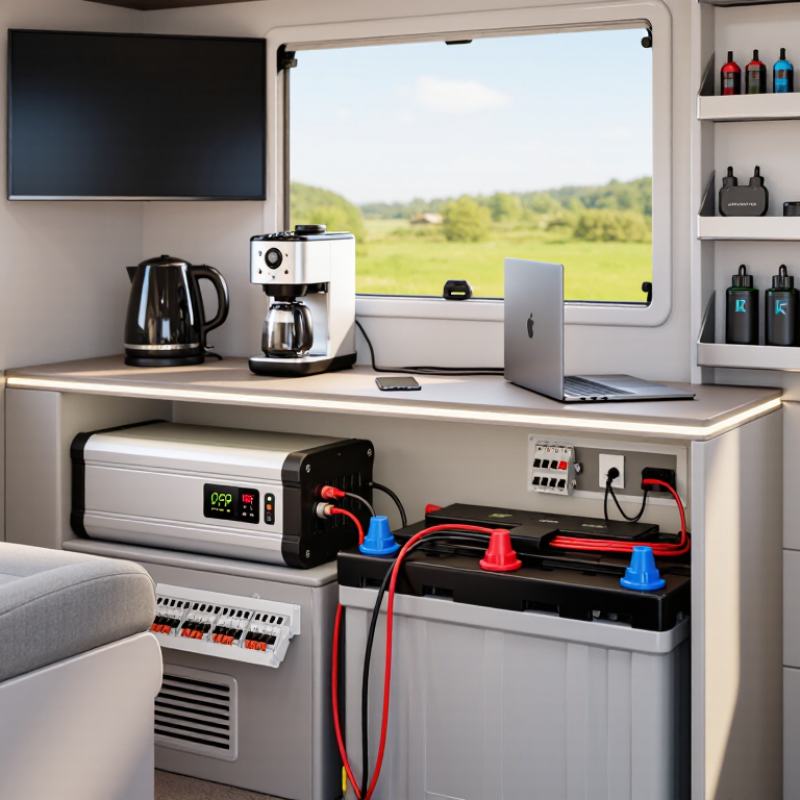
A caravan inverter converts 12-volt or 24-volt battery power into household-style alternating current. This allows you to run selected appliances away from mains electricity. Phone chargers, laptops, small televisions, and kitchen equipment may all benefit. The inverter does not create free energy. It draws power from the battery, often faster than expected.
Power rating matters. Check both continuous output and short-term surge capacity. A coffee machine may require more power when heating than its label suggests. A pure sine wave output is usually safer for sensitive electronics and motor-driven equipment. Efficiency also matters, especially during long evenings without campsite power. Even when no appliance is connected, some inverters consume standby energy.
Battery size should match your daily routine. A 1,000-watt appliance can drain a modest battery quickly. Cable length, cable thickness, fusing, ventilation, and secure mounting deserve equal attention. Poor airflow can cause overheating inside a storage compartment. A qualified installer should check the system against local electrical requirements. Guessing here is risky.
One practical mistake is sizing the inverter for one appliance only. Future use often grows. I would list every intended load, then add a sensible margin. The calculation will not be perfect. Weather, battery age, and charging conditions change real performance. A smaller inverter may be more reliable than an oversized one that encourages careless power use. Test it with your actual appliances before travelling.
Choosing an inverter begins with measuring real power demand, not guessing from battery size. The RV Industry Association’s 2024 Industry Profile estimates that 11.2 million U.S. households own recreational vehicles. That scale makes careful electrical planning essential. List every appliance, its running wattage, and its starting surge. A 900-watt microwave, 120-watt refrigerator, and 60-watt lighting load require 1,080 watts together. Add the highest startup surge, not every surge simultaneously.
Check the appliance label or technical manual. The U.S. Department of Energy’s Energy Saver guidance places many microwave ovens between 600 and 1,200 watts. Compressor refrigerators may briefly draw two to three times their running power. My first estimate was wrong because I ignored that brief demand. It looked acceptable on paper. The inverter still struggled when cooling and heating started together.
Add a safety margin of 20–30 percent to the highest simultaneous load. For a calculated 1,500 watts, a continuous 1,800–2,000-watt inverter is more realistic. Then account for efficiency losses, often around 10 percent, and convert battery capacity carefully: watts multiplied by hours, divided by battery voltage and efficiency. A 500-watt load running for two hours needs roughly 111 amp-hours from a 12-volt battery at 75 percent efficiency. Real camping conditions vary. Cold weather, aging batteries, and cable losses can change the result. Recheck your figures after actual use.
Choosing an inverter starts with your appliances, not its advertised wattage. A fixed inverter suits frequent travel and heavier loads. A portable model works better for occasional trips and smaller devices. Check each appliance’s running power, then allow extra capacity for starting surges. Refrigerators, pumps, and coffee machines can demand much more power briefly.
Waveform matters just as much. A pure sine wave inverter produces smooth electricity, similar to a household socket. It is the safer choice for laptops, medical equipment, induction cookers, audio systems, and appliances with electronic controls. Modified sine wave units cost less and may run simple heaters, lights, or basic chargers. However, some motors can buzz, heat up, or operate poorly. Cheap power can become expensive.
Look closely at battery size, cable thickness, ventilation, and protection features. A powerful inverter connected to a small battery may shut down quickly. That is easy to overlook. Measure the appliance load in real use, especially when several devices run together. I would also leave a sensible margin rather than sizing everything tightly. Manuals provide useful limits, but real campsite conditions can differ. A qualified installer can check polarity, fuses, earthing, and cable routing before use. The perfect choice is rarely the biggest inverter; it is the one that matches your appliances honestly.
How to Choose the Best Caravan Inverter?
Choosing a caravan inverter starts with capacity, not the largest number on the box. List each appliance, its running wattage, and its starting surge. A small fridge may draw 100 watts continuously but demand more briefly. Add simultaneous loads, then keep a 20–30% reserve. That margin feels generous until a charger and kettle run together. Do not confuse peak output with continuous output. My first estimate was too optimistic because I ignored startup demand.
Efficiency matters during quiet camping days. At 12 volts, a 1,000-watt load can pull roughly 93 amps after normal conversion losses. Use the inverter’s tested efficiency at your expected load, not only its best advertised figure. Low-load performance also matters, especially overnight. A low standby draw protects battery capacity. Keep cables short, thick, and properly fused. Warm cables signal trouble.
Safety features deserve careful comparison. Look for low-voltage shutdown, overload protection, short-circuit protection, thermal control, and reverse-polarity protection. A residual-current device may add valuable protection, but installation must match local electrical rules. Ask a qualified installer to verify grounding, ventilation, cable sizing, and battery isolation. Check independent test evidence and clear technical documentation. A pure sine wave output usually suits sensitive chargers and electronics better. Still, no inverter is completely foolproof. A loose terminal can defeat good protection, and I sometimes underestimate how quickly dust blocks cooling airflow.
| Inverter Option | Continuous Output | Typical Surge Capacity | Suitable Caravan Loads | Typical Peak Efficiency | Approximate DC Current at Full Load* | Recommended Battery Bank | Important Safety Features | Best For |
|---|---|---|---|---|---|---|---|---|
| Compact 600 W Pure Sine Wave | 600 W | 1,200 W for a few seconds | Television, laptop, chargers, small fan, low-power kitchen appliances | 90–93% | Approximately 56 A from a 12 V battery system | 100 Ah minimum; larger capacity is preferable for extended use | Low-voltage shutdown, over-temperature protection, overload protection, short-circuit protection, reverse-polarity protection | Light electrical use and short off-grid trips |
| 1,200 W Pure Sine Wave | 1,200 W | 2,400 W for a few seconds | Microwave oven, coffee machine, television, chargers, small food processor | 90–94% | Approximately 111 A from a 12 V battery system | 150–200 Ah, depending on appliance runtime | All standard electronic protections plus fan temperature control and battery-voltage alarm | A balanced choice for many small and medium caravans |
| 2,000 W Pure Sine Wave | 2,000 W | 4,000 W for a few seconds | Microwave oven, coffee machine, induction hob used separately, refrigerator startup, power tools | 91–95% | Approximately 185 A from a 12 V battery system | 200–300 Ah, with correctly sized cables, fuses, and battery protection | Overload and short-circuit protection, thermal shutdown, low- and high-voltage protection, earth-fault or residual-current protection where supported by the installation | Regular off-grid use with several moderate appliances |
| 3,000 W Pure Sine Wave | 3,000 W | 6,000 W for a few seconds | Multiple moderate loads, larger microwave ovens, high-starting-current motor loads, selected air-conditioning systems | 90–94% | Approximately 278 A from a 12 V battery system | 300 Ah or more; a 24 V system can substantially reduce cable current | High-temperature shutdown, overload protection, short-circuit protection, input-voltage protection, remote shutdown, properly rated AC residual-current protection | Large caravans with high electrical demand and adequate battery capacity |
| 2,000–3,000 W Inverter/Charger | 2,000–3,000 W continuous inverter output | Typically 2–3 times the continuous rating, depending on design | AC appliances plus shore-power battery charging and automatic transfer between power sources | 90–95% in inverter mode; charging efficiency varies by battery and charger settings | Approximately 185–278 A from a 12 V battery system at full output | 200–400 Ah or more, sized for the intended load and charging profile | Shore-power transfer protection, configurable charging voltage, overload protection, thermal shutdown, low-voltage cutoff, neutral-earth switching appropriate to the installation | Caravans requiring integrated charging and automatic power management |
Choosing a caravan inverter begins with its continuous load, not its advertised peak power. A 1,000-watt inverter can draw more than 80 amps from a 12-volt battery. At 2,000 watts, current may exceed 166 amps. Use correctly sized cables, a fuse near the battery, and secure crimped terminals. Disconnect shore power and the battery before installation. Never rely on memory. Check polarity twice.
Mount the inverter in a dry, ventilated space away from fuel and battery gases. Keep cooling vents clear. A qualified electrician should verify earthing, residual-current protection, and any transfer switch. Incorrect connections can create dangerous backfeed. NFPA’s Home Structure Fires report for 2016–2020 attributed 24% of home structure fires to electrical distribution and lighting equipment. Caravan wiring deserves equal caution. The RV Industry Association’s 2024 economic impact report estimates that 11 million U.S. households own an RV, so consistent electrical practice matters. During maintenance, inspect cable insulation, heat marks, loose lugs, corrosion, and unusual fan noise. Test protection devices according to local requirements. Clean dust from vents with power isolated. Keep a simple load record for kettles, heaters, and chargers. I still recheck torque after the first trip. Vibration changes things. My earlier mistake was trusting a cool-looking terminal; hidden looseness can generate heat. Use the inverter’s manual and applicable standards, including IEC 60364-7-721, as working references.
Compare typical running and startup power requirements before selecting an inverter. Choose an inverter with continuous output above the combined running load and sufficient surge capacity for appliances with motors or compressors.
Add the running watts of the appliances you may use at the same time, then allow a safety margin of approximately 20–30%. For example, a refrigerator may require significantly more power during compressor startup than during normal operation. Install the inverter close to the battery with correctly sized cables, provide adequate ventilation, keep connections tight and dry, and inspect the system regularly for heat, corrosion, or damaged insulation.
It changes 12-volt or 24-volt battery power into household-style alternating current. It can run selected appliances away from mains electricity. It does not create free energy.
Phone chargers, laptops, small televisions, lights, and some kitchen appliances may work. Check each appliance’s running wattage and starting surge. Small loads are usually easier.
Continuous power supports normal operation. Surge power handles brief starting demands from refrigerators, pumps, and coffee machines. Heating elements may also draw extra power briefly.
Pure sine wave output is smoother and safer for sensitive electronics and motor-driven equipment. It suits laptops, audio equipment, induction cookers, and controlled appliances. Modified output may run simple heaters or lights, but motors can buzz or heat.
List every appliance you may use together. Add a sensible capacity margin for starting surges and future needs. The biggest inverter is not always best.
A 1,000-watt appliance can drain a modest battery quickly. The inverter may shut down after a short period. Battery age and charging conditions change real results.
Thick, suitable cables reduce losses and overheating. Correct fusing helps protect the electrical system. Poor airflow inside a storage compartment can trap dangerous heat. Secure mounting matters too.
Yes. Run your actual appliances together and observe performance. Check charging, shutdowns, cable warmth, and ventilation. Real conditions can differ from manuals. My calculation might still be imperfect.
Choosing the best Caravan Inverter starts with understanding how it converts your battery’s DC power into AC power for household appliances while you travel. Begin by listing the devices you plan to use, checking their running and starting wattage, and adding enough capacity to handle peak demand. This calculation helps prevent overloads and ensures the inverter can support essential equipment without draining the battery unnecessarily.
You should also consider whether a pure or modified waveform is suitable for your appliances, especially sensitive electronics. Compare continuous and surge capacity, energy efficiency, cooling performance, protection against overloads, short circuits, overheating, and low battery voltage. Safe installation is equally important: use correctly sized cables, suitable fuses, adequate ventilation, and secure connections. Regularly inspect wiring, terminals, and ventilation openings, and follow the manufacturer’s instructions to maintain reliable performance. With proper sizing, safety features, installation, and maintenance, a Caravan Inverter can provide convenient and dependable power on the road.

PASS POWER