How to Choose the Best RV Inverter?

Time:2026-09-28 Author:Liam
0%

Choosing the right RV Inverter is less about buying the largest unit and more about matching power to real travel habits. The RV Industry Association reported 333,733 wholesale RV shipments in its 2024 year-end report. That figure describes market activity, not inverter demand, but it reflects the scale of recreational-vehicle use. Inside an RV, electrical needs vary widely: a phone charger is modest, while a microwave or air conditioner can create a much heavier load.

This guide explains how to estimate continuous wattage, account for brief startup surges, and compare pure sine wave and modified sine wave models. Victron Energy’s inverter technical documentation distinguishes continuous output from peak power and emphasizes that connected appliances affect performance. That distinction matters. A refrigerator compressor may briefly draw more power when starting than while running. Battery voltage, cable length, and inverter efficiency also shape what works in practice.

There is no universal best choice. A weekend camper running lights and laptops needs a different setup from a family relying on an inverter for kitchen appliances. Check appliance labels, add realistic simultaneous loads, and verify the battery bank can supply the required current. Leave some margin. Even careful estimates can be wrong, especially when startup loads are overlooked. This overview offers a practical way to compare capacity, waveform, safety features, and installation requirements before choosing an RV Inverter.
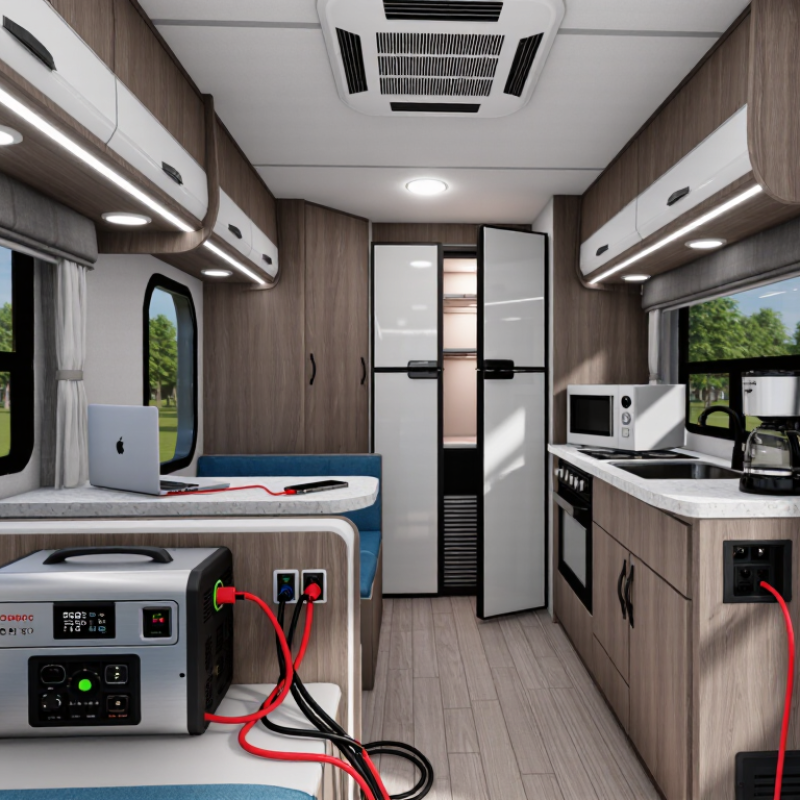
How to Choose the Best RV Inverter?

Understanding the Role of an Inverter in an RV Power System

An RV inverter converts the battery’s 12-volt direct current into the 120-volt alternating current used by household appliances. It lets you run a laptop, television, or coffee maker when shore power is unavailable. It does not create energy; it draws stored energy from the battery and loses some during conversion. Small loads matter.

The battery and inverter work as a pair. For example, a 1,000-watt appliance can draw about 93 amps from a 12-volt battery at 90% inverter efficiency. That high current makes cable size, connection quality, and battery capacity important. NREL’s PVWatts technical documentation uses 96% as a default inverter efficiency for solar modeling. Treat that as a modeling benchmark, not a guarantee for an RV setup; efficiency varies with equipment and load.

Match the inverter’s continuous rating to appliances running together, and check its surge rating for devices with motors, such as a refrigerator. A brief startup surge can exceed normal running demand. Also consider whether you need pure sine-wave output for sensitive electronics. A tidy rating on a product sheet can still mislead: battery condition, cable length, and real-world usage affect performance. Track what you actually run. A week of notes can reveal more than a guess.

Calculating Your RV’s Power Requirements

How to Choose the Best RV Inverter?
Calculating Your RV’s Power Requirements

Start with the appliances you actually plan to use, not the biggest number on a sales label. Record each device’s input watts, expected daily run time, and startup surge. Add daily energy in watt-hours: watts multiplied by hours. For example, a 60-watt laptop used for three hours needs 180 Wh. A 10-watt light running four hours uses 40 Wh. A microwave drawing 1,000 watts for ten minutes adds about 167 Wh. That sample totals 387 Wh, but the microwave sets a much higher momentary power demand. Peak watts matter.

Tips: Read electrical input labels, especially on microwaves and refrigerators. Add together devices likely to run at the same time, then allow a practical margin. Check both continuous and surge ratings; they are not interchangeable. Real use is messier.

The U.S. Energy Information Administration’s 2020 Residential Energy Consumption Survey reports average household electricity use of 10,566 kWh per year. That figure is a useful reminder, not an RV sizing target: travel habits and appliance choices differ sharply. Size the inverter for simultaneous AC loads, then check battery capacity against daily Wh and conversion losses. If a fridge cycles unpredictably, measure its use over a full day. Estimates can miss.

How to Choose the Best RV Inverter: Estimate Your Power Requirements

These are typical estimates; actual wattage varies by appliance, so check each product’s label or manual. Add the running watts of appliances you expect to use at the same time, then make sure the inverter’s surge rating can also handle the startup demand of the largest motor-driven appliance.

Comparing Inverter Types, Waveforms, and Features

How to Choose the Best RV Inverter?
Comparing Inverter Types, Waveforms, and Features

RV inverters generally use modified or pure sine-wave output. Modified sine models can suit simple resistive loads, such as basic heating elements. Some motors, chargers, and sensitive electronics may run noisily or less efficiently on that waveform. Pure sine output more closely resembles household AC power and is usually the more compatible choice. Check each appliance’s manual; “it powered on” does not prove it operates well.

Compare continuous output with the combined wattage of devices used at once, then check surge capacity for startup loads like refrigerators. Also inspect battery voltage, low-voltage protection, cooling, and idle draw. An inverter-charger can combine AC conversion with battery charging, but its charging profile must match the battery. Small details matter. A bright display is less useful than clear fault alerts.

NREL’s 2024 Annual Technology Baseline uses 85% round-trip efficiency as an assumption for utility-scale battery storage. That is a system-level benchmark, not an RV inverter rating, so it should not be used to predict a specific unit’s efficiency. Compare manufacturer test conditions and published efficiency curves instead. One planning mistake is sizing only for normal running watts; startup surges and hot compartments can change the result. Measure your actual loads, and leave room for uncertainty.

How to Choose the Best RV Inverter? - Comparing Inverter Types, Waveforms, and Features

Option What It Means Typical Strengths Limitations Suitable RV Loads What to Check Before Buying
Modified sine wave A stepped, pulse-like AC waveform rather than a smooth sine wave. Often costs less and can run many basic resistive loads, such as simple heating elements. Some motors, chargers, electronics, and appliances may run less efficiently, become noisy or hot, or fail to operate as intended. Basic loads that the appliance manufacturer confirms are compatible. Check every intended appliance’s requirements; do not assume a device will work because its wattage is within the inverter rating.
Pure sine wave Produces a smooth AC waveform similar to utility power. Broad compatibility with sensitive electronics, many motor loads, and appliances that specify sine-wave power. Usually costs more than a comparable modified-sine model; correct sizing and installation are still essential. Laptops, televisions, many refrigerators, battery chargers, and other loads requiring clean AC power. Compare continuous output, surge rating and duration, output voltage and frequency, and compatibility with the RV’s electrical system.
Inverter/charger Combines an inverter with a battery charger; many models also provide AC transfer switching. Can power selected AC circuits from the battery and recharge batteries when shore power or a generator is available. More installation and configuration considerations; charging capability and waveform vary by model. RVs that need an integrated battery-charging and backup-power arrangement. Verify battery chemistry settings, charging current, transfer-switch rating, neutral-ground behavior, and which circuits will be supplied.
High-frequency design A switching-based inverter design that typically uses high-frequency electronics and a smaller transformer or no large line-frequency transformer. Often lighter and more compact, which can be useful where RV space and payload are limited. Surge performance and overload behavior vary widely; the design label alone does not establish durability or suitability. Loads within the unit’s continuous and surge ratings, especially when lower weight is a priority. Use published surge watts and duration, overload protection details, cooling requirements, and installation instructions to compare models.
Low-frequency transformer design Uses a larger line-frequency transformer; this describes the design, not the output waveform. Some models offer strong short-duration surge capability for motor starting. Typically heavier and bulkier; actual surge capacity, efficiency, and output quality are model-specific. Installations where documented motor-starting surge capacity is important and weight is less restrictive. Compare the rated surge duration and overload limits, not just a peak-watt number; confirm space, mounting, and ventilation needs.
Inverter with remote monitoring or control Adds a remote display, control panel, or monitoring features; these may be available with different inverter designs. Can make it easier to check operating status, alarms, and settings without accessing the inverter itself. Extra features do not increase the inverter’s power capacity; remote accessories and monitoring functions differ by model. RVs where the inverter is installed in a hard-to-reach compartment or where routine status checks are useful. Confirm what the display monitors, whether the remote is included, and whether the communication system is compatible with other equipment.

Selection note: Add the running wattage of the loads you expect to use at the same time, then account for the starting surge of motor-driven appliances. Check battery voltage, available battery capacity, wiring and fuse requirements, ventilation, and the inverter manufacturer’s installation guidance. Ratings and features vary by model.

Checking Battery, Wiring, and Installation Compatibility

How to Choose the Best RV Inverter?

Checking Battery, Wiring, and Installation Compatibility

Before comparing inverter wattage, check the battery bank’s voltage and usable capacity. The inverter must match the bank, and its continuous rating should cover the appliances you may run together. Allow extra surge capacity for compressor fridges or pump motors. A 1,000-watt AC load can draw well over 80 amps from a 12-volt battery after losses. That detail changes cable and battery choices.

Tips: Check the battery’s discharge limit and battery-management-system rating. Measure the cable route, not just the straight-line distance. Shorter, correctly sized cables reduce voltage drop and heat.

Wiring is not an afterthought. Use cable and overcurrent protection sized to the inverter manual, current, and cable length; place the fuse close to the battery. Avoid guessing from a photo online.

Installation also needs firm mounting, airflow, and protection from water and exhaust heat. Keep the unit accessible for inspection, with connections tightened to the specified torque. A tidy install can still be incompatible if the battery cannot supply the current. I would recheck the load list after installation, because real use often differs from the plan.

For uncertain AC wiring or grounding, ask a qualified RV technician to inspect the setup.

Evaluating Efficiency, Safety, Durability, and Warranty

Efficiency, Safety, Durability, and Warranty

A suitable RV inverter should match your real loads, not just the largest number on its label. List appliances, starting surges, and expected run times. The U.S. Department of Energy’s Energy Saver guidance places typical inverter efficiency around 90–95%. That difference matters: at 90% efficiency, a 1,000-watt load draws roughly 1,111 watts from the battery, before other losses. Check efficiency at the loads you use most, not only peak performance.

Safety needs equal attention. Look for clear overload, over-temperature, and low-voltage protection, plus installation instructions suited to an RV’s wiring and ventilation. UL 458 covers power converters and inverters for recreational vehicles and marine use; verify the exact listing, rather than relying on vague “tested” wording. Heat is a quiet durability test. NREL’s photovoltaic inverter reliability research highlights operating conditions and thermal stress as factors in component reliability, though solar systems are not identical to RV setups. Small details matter. A cramped cabinet can undermine a capable unit.

Compare warranty length, exclusions, and who pays labor or shipping. A long warranty may still exclude damage linked to poor ventilation or undersized cables. I would not treat any single rating as decisive; spec sheets rarely capture rough roads, dusty compartments, or hurried installations. Check the manual against your battery voltage, continuous load, and available mounting space.

FAQS

What does an RV inverter do?

It converts 12-volt battery power into 120-volt AC power for household appliances. It does not create energy. Small loads count.

How much battery current can a 1,000-watt appliance use?

At 90% inverter efficiency, it may draw about 93 amps from a 12-volt battery. That is a substantial load.

How do I choose an inverter’s power rating?

Match its continuous rating to appliances running at the same time. Check the surge rating for refrigerators and pump motors.

Does inverter efficiency stay constant?

No. Efficiency varies with equipment and load, and some battery energy is lost during conversion. A model’s stated figure is not a guarantee.

What battery details should I check?

Confirm the battery bank’s voltage, usable capacity, discharge limit, and management-system rating. The battery must supply the inverter’s current.

Why do cable length and size matter?

High current and long cables can increase voltage drop and heat. Measure the actual route, then follow the inverter manual for cable and fuse sizing.

Where should the fuse and inverter go?

Place the fuse close to the battery. Mount the inverter firmly, with airflow and protection from water and exhaust heat.

Do I need pure sine-wave output?

It may be appropriate for sensitive electronics. Check appliance requirements rather than guessing from the power rating.

How can I check whether my setup works in daily use?

Keep notes on what you run for a week, then review the load list. I would still recheck it after installation; plans can be optimistic.

When should an RV technician inspect the system?

Ask a qualified technician to inspect uncertain AC wiring or grounding. Connections also need the specified tightening torque.

Conclusion

Choosing the best RV Inverter starts with understanding how it converts battery power into electricity for the appliances and devices used in your recreational vehicle. Estimate your total power needs by listing the equipment you expect to run and accounting for both its operating wattage and any brief startup demands. This helps you select an inverter with suitable capacity without overloading your power system.

Next, compare inverter types, output waveforms, and useful features, then check that the unit is compatible with your batteries, wiring, and installation space. Consider efficiency, built-in safety protections, construction quality, and warranty coverage as part of your decision. A well-matched RV Inverter can provide dependable power while helping protect connected equipment and making better use of your available battery capacity.


Liam

Liam

Liam is a dedicated marketing professional with a profound expertise in the industry, where he excels at highlighting the unique advantages of our core products. With a keen understanding of market trends and consumer needs, Liam frequently updates our company’s professional blog, providing......